How to Boost LinkedIn Engagement with Smart Comments
Comments are the cheapest reach on LinkedIn and almost nobody uses them well. What a good one looks like, and how to keep it up on the days you have no time.

· 7 min read · Updated
On this page
Most people treat LinkedIn as a publishing platform. They write a post, hit publish, and close the tab. Then they wonder why nothing compounds.
The accounts that grow fastest are usually not the best writers. They are the ones in the comments, every day, saying something worth reading on other people’s posts. A good comment costs you ninety seconds and puts your name in front of an audience someone else spent months building.
The problem is not that people disagree with this. It is that commenting well, every day, is genuinely hard to sustain.
Why LinkedIn Engagement Matters
One caution before the tactics: LinkedIn now names comment automation and engagement pods in its own enforcement language, so the shortcuts are riskier than they were. How the algorithm works in 2026 has the detail.
Drives Visibility
LinkedIn’s algorithm rewards active accounts. According to LinkedIn, members who engage weekly receive 5x more profile views, 4x more connection requests, and 7x more inbound messages.
A comment is also a post you did not have to write. It appears under content that is already getting attention, and if it is good, people click your name.
This is the part that surprises people: on a busy post, a thoughtful comment can be seen by more people than your own last three posts combined. You borrowed the author’s audience, and it cost you a minute.
Builds Meaningful Connections
Connection requests from strangers get ignored. Connection requests from someone whose comments you have been reading for a month get accepted.
Commenting is how you stop being a stranger before you ask for anything. Most of the useful relationships on LinkedIn start with several months of showing up in someone’s replies, not with a pitch.
Positions You as Someone Worth Following
This is not a soft benefit, and it is the core of LinkedIn personal branding. Three in four decision-makers trust thought leadership over product sheets and marketing material, and 95% of the hidden stakeholders in a buying group are more open to outreach after strong thought leadership (LinkedIn and Edelman, 2025).
You do not need to publish regularly to earn that. If you consistently say sharp things about pricing, or hiring, or infrastructure, in other people’s threads, people start associating you with that subject.
That is a reputation built entirely out of comments, and it is available to anyone who does not have time to write posts.
Attracts Opportunities
Recruiters, buyers, and future co-founders read comments. Familiarity is most of what turns a name into a conversation, and comments generate familiarity far faster than an occasional post does.
Best Practices for Commenting on LinkedIn
Be Authentic
“Great post” and “Totally agree” are worse than nothing. They take up space and signal that you did not read it.
Say the specific thing you thought while reading:
“I’ve started using Pomodoro blocks for deep work and it’s made a real difference. Good reminder.”
Twenty words that could only have been written by someone who read the post beat two hundred generic ones.
Ask Thoughtful Questions
A question does two jobs: it shows you engaged with the argument, and it usually gets a reply from the author, which puts the exchange in front of more people.
“Interesting take. How do you see this working for remote teams spread across several time zones?”
Ask something you actually want answered. Rhetorical questions read as performance.
Share Insights or Data
The most valuable comment is the one that adds information the post did not have. Your own experience counts, especially the parts that did not work.
“We tried switching to async standups and saved around 4 hours per week, definitely worth exploring.”
Numbers from your own work are more persuasive than any statistic you could quote, and nobody can argue with them.
Give Genuine Appreciation
Praise is fine. Inflated praise is not, because it makes everything else you say worth less.
Instead of: “This is the best post ever!”
Try:
“I appreciate how you broke this down. It’s rare to see such a practical take.”
Tag Relevant People
Tagging someone who genuinely has something to add is useful. Tagging three people to farm reach is obvious, and it annoys everyone you tagged.
“@AhmedAli this aligns with what you were saying about team productivity last week.”
One tag, with a reason, or none.
How Depost AI Helps You Engage More on LinkedIn
Knowing what a good comment looks like is the easy part. Doing it on a Tuesday with four meetings is the hard part, and that is the gap Depost AI is built for.
A Feed Worth Commenting On
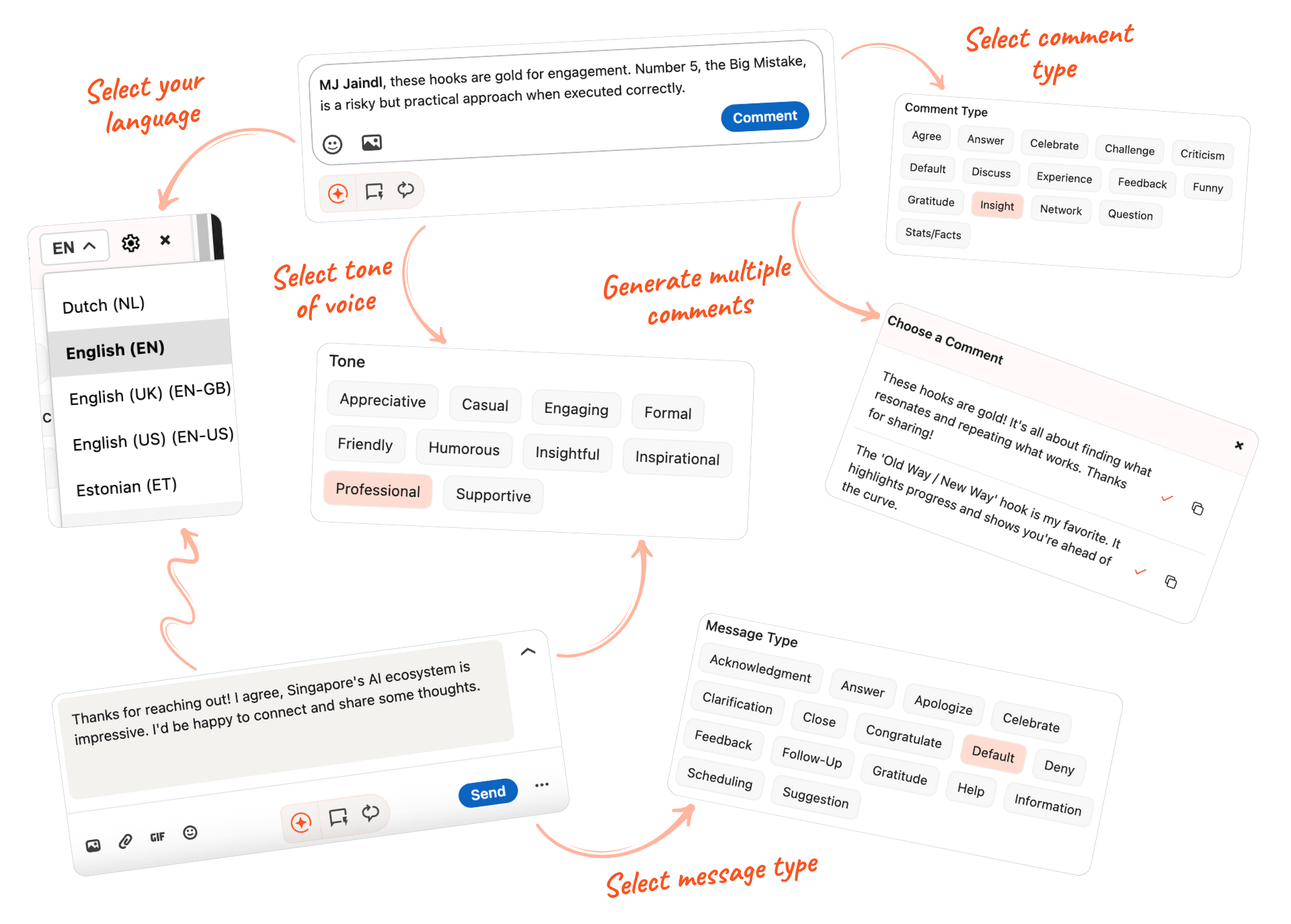
Half the battle is finding posts worth your time. Instead of scrolling the main feed, you build targeted feeds around the people and topics that matter to you, so the posts you should be replying to are in one place.
Drafts in Your Voice, Not a Template
Depost AI reads the post and drafts a reply that fits it, in a voice learned from your own writing. You pick the angle, whether that is adding a point, asking a question, or backing the author up.
“Thanks for being honest about this. I’ve had similar stretches, and this landed.”
Nothing is posted for you. Every reply is a draft you read, edit, and send yourself. There is no automation posting comments under your name, which is exactly the behavior that gets LinkedIn accounts restricted.
If you want to see the drafting before connecting anything, the free comment generator takes a post and writes a reply in your tone, right in the browser.
Edit Before You Send
Drafts are a starting point, not an output. You can rewrite a line, change the tone, cut it in half, or throw it away. The point is never staring at an empty comment box, not outsourcing your opinion.
Advantages of AI-Powered Engagement
Save time. The slow part of commenting is not typing, it is deciding what to say. Starting from a draft turns a ten-minute task into a two-minute one.
Stay consistent. Engagement works because it is daily. Most people fail at the daily part, not the quality part.
Stay visible. Showing up in the same threads, week after week, is how people start recognizing your name.
Still sound like you. The drafts are built from your own published writing, and you edit them before they go out. If a reply does not sound like you, do not send it.
It works. Depost AI users have reported up to 30 to 50% higher post reach within weeks, just by increasing how often they engage.
Conclusion
LinkedIn is not only about writing posts that travel. Half of it is being present in other people’s threads, saying things worth reading, for long enough that people know who you are.
That is unglamorous work, and it is the part most people quit. Anything that makes the daily version easier is worth more than another posting tip.
FAQ
Why should I focus on commenting instead of just posting on LinkedIn?
Because comments are cheaper and compound faster. A post requires an idea, a draft, and an edit. A comment requires ninety seconds and puts you in front of an audience someone else built. According to LinkedIn, posts that attract comments can see up to 3x more visibility, because engagement signals tell the algorithm the content is worth showing more widely. Do both if you can, but if you only have time for one, comment.
How often should I engage with others on LinkedIn?
Ten thoughtful comments a day, in the same handful of threads and communities, is a rhythm most people can hold. If commenting is your main channel, 50 to 100 across two or three sessions is sustainable, and how many comments a day is safe covers the shape that keeps it that way. Twenty minutes done consistently beats a three-hour burst once a fortnight.
Can AI-generated comments sound authentic?
They can when they are drafted from your own writing and you edit them before sending. They cannot when they are posted automatically and untouched, which is why Depost AI never posts a comment for you.
Will using AI tools violate LinkedIn’s terms?
Automating activity at scale will get an account restricted. Drafting a reply that you then read, edit, and send yourself is no different from using a spellchecker. Depost AI sends no automated comments, DMs, or connection requests by design.
How do I choose the right tone when replying to posts?
Match the room. A leadership post from a CEO and a career win from a peer call for different registers. If you are unsure, go plainer rather than warmer, since forced enthusiasm reads worse than being a little dry.
What makes a good LinkedIn comment?
It adds something the post did not have. Instead of “Great post,” try:
“We ran this last year and it moved lead quality more than volume. Curious whether you saw the same split.”
That gives the author something to reply to, which is what turns a comment into a conversation.